Christopher Gadsden led the Sons of Liberty in
South Carolina starting in 1765, and was later made a colonel in
the Continental Army. In 1775 he was in Philadelphia representing
his home state in the Continental Congress. He was also one of
three members of the Marine Committee who decided to outfit and
man the Alfred and its sister ships as a personal responsibility.
Gadsden and Congress chose a Rhode Island man, Esek Hopkins, as
the commander-in-chief of the Navy. The flag that Hopkins used as
his personal standard on the Alfred is the one we now call
"The Gadsden Flag."
Gadsden also presented a copy of this flag to his state
legislature in Charleston. This is recorded in the South Carolina
congressional journals:
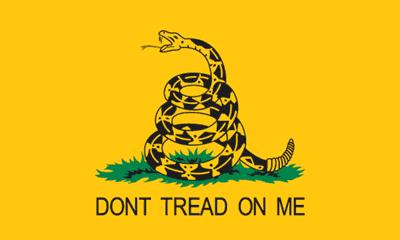
"Col. Gadsden presented to the Congress an elegant standard,
such as is to be used by the commander in chief of the American
navy; being a yellow field, with a lively representation of a
rattle-snake in the middle, in the attitude of going to strike,
and these words underneath, 'Don't Tread on Me!' "
Unofficial usage of the Gadsden
flag by the U.S. government has been seen, particularly in the
wake of September 11, 2001, most notably by the Customs Service
and harbor patrol boats in U.S. ports and individuals serving
abroad in the U.S. military. The First Navy Jack, which was
directly related to the Gadsden flag, has also been in use by the
U.S. Navy, and since the terrorist attack on the World Trade
Center towers and the Pentagon, on all active naval ships.
Beginning in 2009, the Gadsden
Flag has become an adopted symbol of many of the American Tea
Party movements. Many Tea Party members have embraced the
"Don't Tread on Me" flag and its message. It serves as
an alternative to the stars and stripes for Tea Party protesters
upset at the current government yet still feeling patriotic. It
has also been seen being displayed by members of Congress at Tea
Party rallies.
The final paragraph of the
article is obviously incorrect. I, for one, am completely in
favor of the Sequester Cuts because even though they almost
occurred by accident through inaction by the members of Congress
rather than action... they are the first spending cuts we have
seen since President You-Know-Who took office in 2009. I am
reminded of the W.S. Gilbert lyrics from Iolanthe:
"When Wellington thrashed Bonaparte,
As every child can tell,
The House of Peers, throughout the war,
Did nothing in particular,
And did it very well..."
By doing nothing, and doing it
very well, Congress has managed to begin cutting our national
spending. Thus my Gadsden Flag will fly until they either cave in
and get rid of the Sequester Cuts, or until all of the Sequester
Cuts have taken place (fat chance!).
Meanwhile, keep your eye on the
debt clock to see how much we owe.
04/01/15
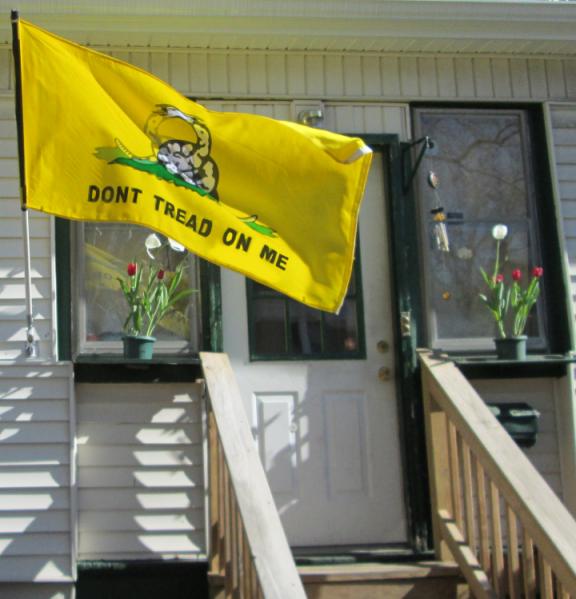
As the one and only member of the
East Orange Tea Party, I have declared the month of April to be
"Tea Party Month" in East Orange, and will fly my
Gadsden Flag from April 1st to April 15th as a protest against
the rising tax rate in East Orange and the failure of the current
mayor to carry out his campaign pledges to lower taxes. Instead
he raised our property taxes two years in a row, and intends to
raise them until 2017, at which point, if the citizens of East
Orange have had enough, they will vote him out of office for his
failure to keep his word.
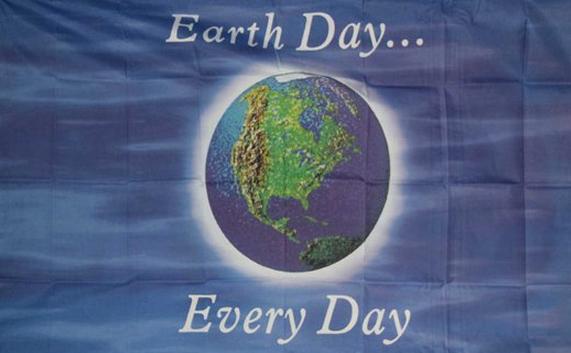
From April 16th to April 30th I
will be flying the Earth Day Flag. This has nothing to do with
climate change or global warming or cooling or any of that
pseudo-science guesswork. This has to do with something REAL that
we humans have caused with no doubt about it- pollution. We are
the masters of polluting our environment wherever we choose to
live. We have been doing it since humans first became
"civilized" and our garbage from prehistoric times is
what archeologists get paid to collect and study. Only now we can
produce more garbage and litter than ever before, and THAT is
what we should be correcting. Recycling is only part of the
answer, and we need to seriously get involved in cleaning up our
own environment before we worry about tampering with global
ecology.